Teach Spanish Through Art
Why do students go silent in Spanish class? Get the free activity →
Most Spanish practice gives students something to memorize or repeat — a vocabulary list, a grammar drill, a scripted dialogue. What it rarely gives them is a reason to actually think in Spanish.
Artwork changes that. When students look closely at a painting and start to describe what they see, something different happens. The visual element gives them an anchor. The observation process creates genuine things to say. One detail noticed leads to another, one phrase builds on the next — and the discussion grows because there’s actually something worth talking about.
That’s what makes art study one of the most effective contexts for real language production. And it’s the foundation of Historia de Arte — a reusable Spanish teaching system built around any artwork, with the script, the structure, and the vocabulary already in place so you can lead rich discussion in Spanish and watch your students produce language you didn’t think they had.
Why Art Study Works for Spanish
Art study builds language skills in a way most classroom activities don’t — because it starts with real thinking rather than retrieval.
When a student looks at a painting and tries to describe what they see, they’re doing something cognitively different from answering a grammar question or completing a fill-in-the-blank. They’re forming an observation, reaching for vocabulary, constructing a sentence to express something they actually noticed. That process — thinking first, then producing language — is exactly how fluency develops.
Art study also builds all five language skills in a single lesson. Students listen to prompts and discussion. They speak to share observations and respond to each other. They read vocabulary and artist context. They write reflections and analysis. They think — directly in Spanish — about what they’re seeing.
Few classroom activities create that combination naturally. Picture study does.
What Historia de Arte Includes
Historia de Arte is a complete, reusable system. You build it once around any artwork or artist and use it again and again with different classes and different levels.
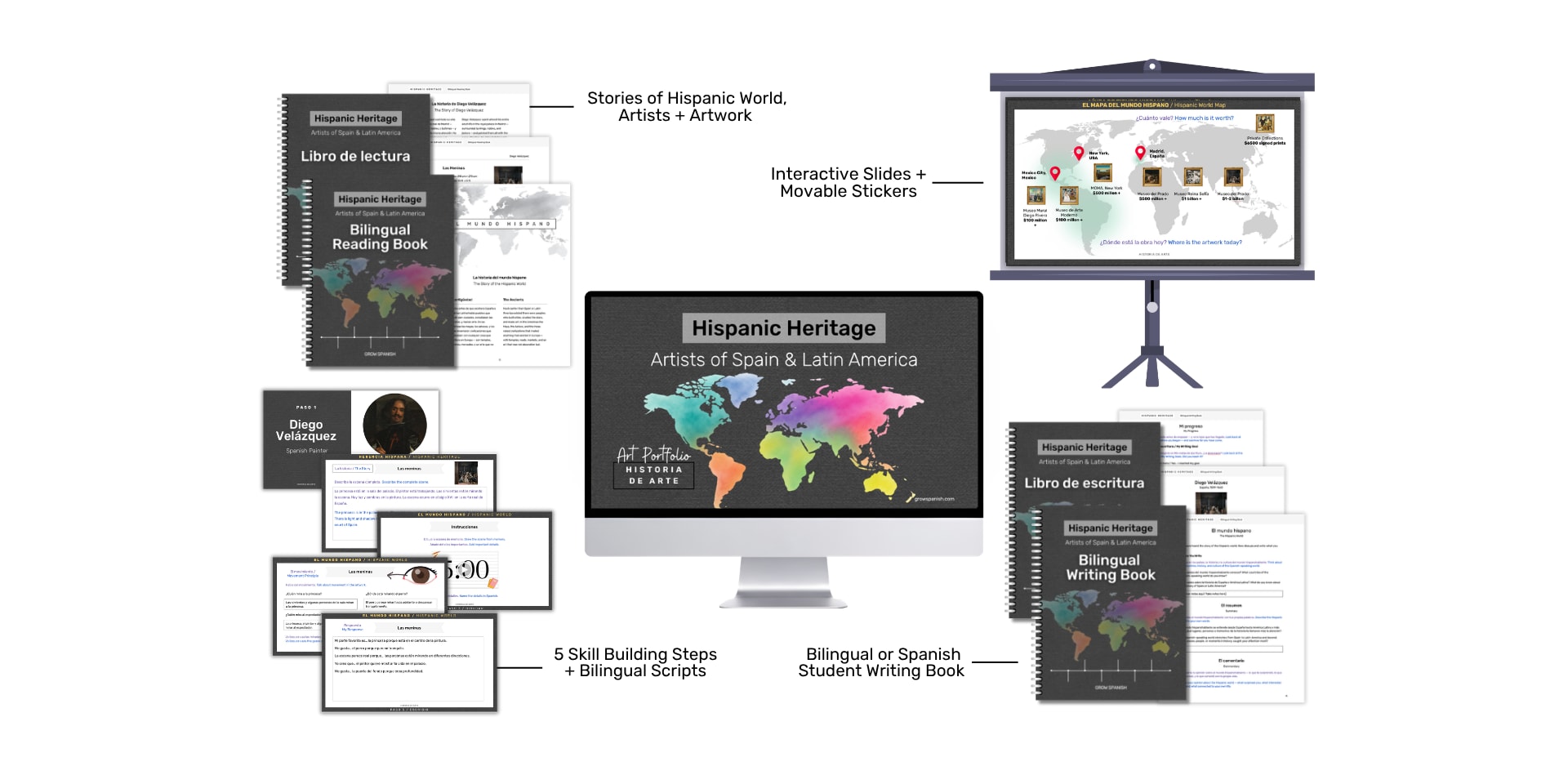
4-Part Program Walkthrough — five focused modules that walk you through the full teaching system, from preparation to execution. Prepare your lesson, guide students before class, lead engaging discussion, and wrap up with purpose. Each module builds on the last.
Discussion Guide — teacher prompts and vocabulary menus built for any artwork, artist, or art form. Your script is ready before you walk into the room — so you can lead rich observation and discussion in Spanish even when you’re not a native speaker.
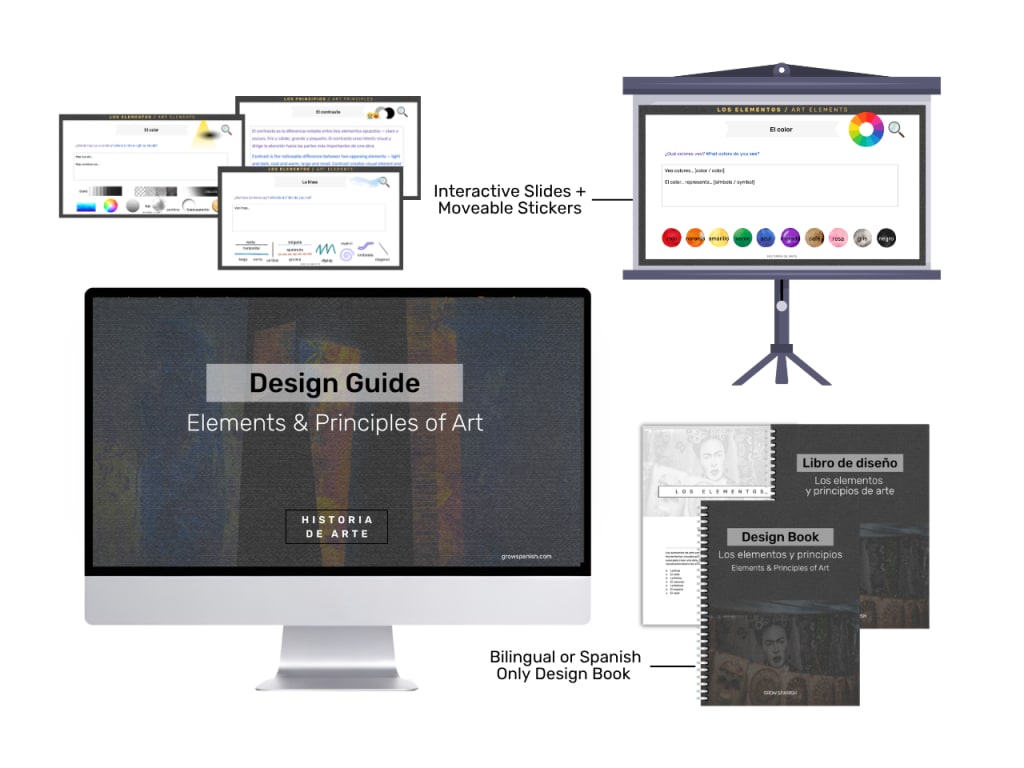
Interactive Slides — a fully customizable slide deck with moveable stickers for the specific artist, artwork, and student level you’re teaching. Adapt in minutes. Use them again and again.
Vocabulary Menu — a curated set of high-utility Spanish vocabulary to support artwork-based lessons. Helps students describe, analyze, and discuss with more depth while making it easy to scaffold speaking and writing in context.
Teacher Toolkit — the professional backbone of the system. Includes a program guide checklist, lesson plan template, and unit tracker so you can plan, implement, and track progress with confidence.
Student Notebook — a fillable Google Doc where students set goals, work through each step, and reflect on what they noticed, discussed, and produced. Every student builds their own record of growth.
Bonus: Storytelling Through Art — a bonus resource to build your confidence describing art in Spanish. Know what to look for, what to say, and how to say it — so you can guide your students through any piece without hesitation.
Artists and Topics to Explore
Historia de Arte works with any artwork — but these posts go deeper on specific artists and art concepts, with vocabulary and discussion ideas you can bring directly into your lessons.
Artists: → Diego Rivera — muralism, Mexican history, political art → Fernando Botero — figurative art, Latin American identity, scale and proportion
Art Concepts: → Art Appreciation in Spanish — how to look at and talk about art in Spanish → Describing the Elements of Art in Spanish — line, color, shape, texture, form, space, value → Principles of Art in Spanish — balance, contrast, emphasis, movement, pattern, rhythm, unity → Spanish Art Vocabulary — the core vocabulary for any art discussion → Drawing Vocabulary in Spanish — vocabulary specific to drawing and illustration → Preparing for Art Study in Spanish — how to set up and structure an art study lesson → Describing Art in Spanish — language for observation, interpretation, and response
Who Historia de Arte Is For
Historia de Arte is built for Spanish teachers who want to bring real communication into their classroom without spending hours building lessons from scratch.
It works for classroom teachers at any level — middle school, high school, university — who want engaging content that produces real language. It also works for tutors and homeschool educators who want a structured system they can adapt to their student’s level and interests.
If you’ve been looking for a way to create genuine discussion in Spanish rather than just drilling vocabulary and grammar, this is the system.
Closing Thoughts
The best Spanish lessons don’t feel like Spanish lessons. They feel like conversations — about something real, something visible, something worth talking about.
Art gives you that. Historia de Arte gives you the system to make it happen consistently — with any artwork, any class, any level — so you can walk into the room ready to lead instead of scrambling to prepare.
Keep Going →
→ Diego Rivera – Mexican Muralist — a complete artist study with discussion vocabulary and lesson ideas → Fernando Botero – Colombian Artist — Latin American art that generates rich student discussion → Describing Art in Spanish — the observation language your students need to participate fully